Spreading activation is a method for searching associative networks, biological and artificial neural networks, or semantic networks. The search process is initiated by labeling a set of source nodes (e.g. concepts in a semantic network) with weights or "activation" and then iteratively propagating or "spreading" that activation out to other nodes linked to the source nodes. Most often these "weights" are real values that decay as activation propagates through the network. When the weights are discrete this process is often referred to as marker passing. Activation may originate from alternate paths, identified by distinct markers, and terminate when two alternate paths reach the same node. However brain studies show that several different brain areas play an important role in semantic processing. Spreading activation in semantic networks as a model were invented in cognitive psychology to model the fan out effect. Spreading activation can also be applied in information retrieval, by means of a network of nodes representing documents and terms contained in those documents. == Cognitive psychology == As it relates to cognitive psychology, spreading activation is the theory of how the brain iterates through a network of associated ideas to retrieve specific information. The spreading activation theory presents the array of concepts within our memory as cognitive units, each consisting of a node and its associated elements or characteristics, all connected together by edges. A spreading activation network can be represented schematically, in a sort of web diagram with shorter lines between two nodes meaning the ideas are more closely related and will typically be associated more quickly to the original concept. In memory psychology, the spreading activation model holds that people organize their knowledge of the world based on their personal experiences, which in turn form the network of ideas that is the person's knowledge of the world. When a word (the target) is preceded by an associated word (the prime) in word recognition tasks, participants seem to perform better in the amount of time that it takes them to respond. For instance, subjects respond faster to the word "doctor" when it is preceded by "nurse" than when it is preceded by an unrelated word like "carrot". This semantic priming effect with words that are close in meaning within the cognitive network has been seen in a wide range of tasks given by experimenters, ranging from sentence verification to lexical decision and naming. As another example, if the original concept is "red" and the concept "vehicles" is primed, they are much more likely to say "fire engine" instead of something unrelated to vehicles, such as "cherries". If instead "fruits" was primed, they would likely name "cherries" and continue on from there. The activation of pathways in the network has everything to do with how closely linked two concepts are by meaning, as well as how a subject is primed. == Algorithm == A directed graph is populated by Nodes[ 1...N ] each having an associated activation value A [ i ] which is a real number in the range [0.0 ... 1.0]. A Link[ i, j ] connects source node[ i ] with target node[ j ]. Each edge has an associated weight W [ i, j ] usually a real number in the range [0.0 ... 1.0]. Parameters: Firing threshold F, a real number in the range [0.0 ... 1.0] Decay factor D, a real number in the range [0.0 ... 1.0] Steps: Initialize the graph setting all activation values A [ i ] to zero. Set one or more origin nodes to an initial activation value greater than the firing threshold F. A typical initial value is 1.0. For each unfired node [ i ] in the graph having an activation value A [ i ] greater than the node firing threshold F: For each Link [ i, j ] connecting the source node [ i ] with target node [ j ], adjust A [ j ] = A [ j ] + (A [ i ] W [ i, j ] D) where D is the decay factor. If a target node receives an adjustment to its activation value so that it would exceed 1.0, then set its new activation value to 1.0. Likewise maintain 0.0 as a lower bound on the target node's activation value should it receive an adjustment to below 0.0. Once a node has fired it may not fire again, although variations of the basic algorithm permit repeated firings and loops through the graph. Nodes receiving a new activation value that exceeds the firing threshold F are marked for firing on the next spreading activation cycle. If activation originates from more than one node, a variation of the algorithm permits marker passing to distinguish the paths by which activation is spread over the graph The procedure terminates when either there are no more nodes to fire or in the case of marker passing from multiple origins, when a node is reached from more than one path. Variations of the algorithm that permit repeated node firings and activation loops in the graph, terminate after a steady activation state, with respect to some delta, is reached, or when a maximum number of iterations is exceeded. == Examples ==
Representation collapse
Representation collapse is a phenomenon in machine learning and representation learning where a model maps different inputs to the same or very similar embeddings, which means it loses important information about how the data is spread out. It is frequently encountered in self-supervised learning, especially within contrastive and non-contrastive frameworks, when training objectives or model architectures do not maintain variance across representations. Collapse results in degenerate solutions characterized by uninformative learned features, significantly impairing downstream task performance. Various techniques have been proposed to mitigate representation collapse, including the use of negative samples, architectural asymmetry, stop-gradient operations, variance regularization, and redundancy reduction objectives, as seen in methods such as SimCLR, BYOL, and VICReg. Comprehending and averting representation collapse is regarded as a fundamental challenge in the advancement of stable and efficient self-supervised learning systems.
GPT-5
GPT-5 is a multimodal large language model developed by OpenAI and the fifth in its series of generative pre-trained transformer (GPT) foundation models. Preceded in the series by GPT-4, it was launched on August 7, 2025. It is publicly accessible to users of the chatbot products ChatGPT and Microsoft Copilot as well as to developers through the OpenAI API. == Background == On April 14, 2023, Sam Altman, the chief executive officer of OpenAI, spoke at an event at the Massachusetts Institute of Technology and said that the company was not training GPT-5 at that time. He stated that OpenAI was "prioritizing GPT-4 development" and that "we are not and won't for some time" release GPT-5. On July 18, OpenAI filed for a "GPT-5" trademark in the United States. On November 13, Altman confirmed to the Financial Times that the company was working to develop GPT-5. According to The Information, "[f]or much of the second half of 2024, OpenAI was developing a model known internally as Orion and intended to become GPT-5", "[b]ut the Orion effort failed to produce a better model, and the company instead released it as GPT-4.5 in February [2025]." By late July 2025, OpenAI was widely anticipated as planning to release GPT-5 in early August. On July 30, The Verge reported that "Microsoft is getting ready for GPT-5" as "sources familiar with Microsoft's AI plans" told an editor that the company was testing a new mode for its Copilot chatbot that would offer a model that "thinks deeply or quickly based on the task". On August 5, in the leadup to the release of GPT-5, OpenAI released GPT-OSS, a set of two open-weight models that have reasoning capabilities. GPT-5 was then unveiled during a livestream event on August 7. == Capabilities == At the time of its release, GPT-5 had state-of-the-art performance on benchmarks that test mathematics, programming, finance, and multimodal understanding. According to OpenAI, improvements over its predecessor models include faster response times, better coding and writing skills, more accurate answers to health questions, and lower levels of hallucination. Also, compared to previous models, GPT-5 aims to give safe, high-level responses to potentially harmful queries rather than outright declining them, an approach that OpenAI refers to as "safe completions", aiming to result "in GPT-5 being able to refuse more unsafe questions, while offering fewer rejections to users seeking harmless information." In addition, GPT-5 was trained to give more critical, "less effusively agreeable" answers compared to its predecessor models. Days before the launch of GPT-5, two early testers of the model stated that they were "impressed" by its ability to code and to solve mathematical and scientific problems. They suggested that the model shows great improvement from GPT-4, but not as large of a gain as from GPT-3 to GPT-4. A day prior to the release of GPT-5, during a press briefing, Sam Altman, the chief executive officer of OpenAI, called GPT-5 "a significant step along the path to AGI", referring to artificial general intelligence, the hypothetical level of intelligence that OpenAI defines as the ability to perform any economically valuable task that a human can. According to Altman, GPT-5 is "significantly better" than its predecessors, offering "PhD-level" abilities across a wide range of tasks. The exact energy consumption of GPT-5 use has not been disclosed by OpenAI. Researchers at the University of Rhode Island estimated that a medium-length response consumes slightly over 18 watt-hours, equivalent to using an incandescent bulb for 18 minutes. === Architecture === GPT-5 is a system that contains a fast, high-throughput model, a deeper reasoning model, and a real-time router that decides which model to use based on conversation type, complexity, tool needs, and explicit user intent. Altman had previously criticized the manual model picker for being overly complex, suggesting a need for unification. GPT-5 also includes agentic functionality through which it can set up its own desktop and can use its browser to search autonomously for sources that relate to its task. The GPT-5 system card defines two fast, high-throughput models – gpt-5-main and gpt-5-main-mini – and two thinking models – gpt-5-thinking and gpt-5-thinking-mini. In the OpenAI API, developers can access the thinking model, its mini version, and gpt-5-thinking-nano, an even smaller and faster nano version of the thinking model. The version of GPT-5 that is accessible via the API has adjustable reasoning effort (low, medium, high, or minimal) and verbosity (low, medium, or high). Additionally, ChatGPT provides access to gpt-5-thinking with a setting that makes use of parallel test-time compute, referred to as gpt-5-thinking-pro. == Limitations == === Safety === Neuraltrust, a security research company, claimed to have successfully compromised GPT-5 within its first day of testing the model. According to its report, it enabled GPT-5 to generate detailed instructions for manufacturing explosive devices. SPLX, another company, conducted similar tests and came to similar conclusions about GPT-5's security. Their assessments suggest that GPT-5 has significant security gaps, potentially rendering it as being unsafe for use in a corporate environment. == Training == According to AIMultiple, GPT-5 is natively multimodal, meaning that it was trained from scratch on multiple modalities (like text and images) at once without relying on already-trained language or vision models. Its training process involved three stages: unsupervised pretraining, supervised fine-tuning, and reinforcement learning from human feedback. Pretraining used a large-scale multilingual dataset of books, articles, web pages, academic papers, and licensed sources. GPT-5's visual and text capabilities were described as having been developed alongside each other throughout training, unlike with GPT-4. == Use == GPT-5 is used in ChatGPT. Although GPT-5 is free for all ChatGPT users, Plus users get higher use limits while Pro users get unlimited access to GPT-5 as well as limited access to GPT-5 Pro. Standard limits for lower-tier users on responses per hour still apply. Additionally, with the introduction of GPT-5, ChatGPT's "Advanced Voice Mode" was replaced by "ChatGPT Voice", which is supposed to enable more natural-sounding conversations. OpenAI stated that "Standard Voice Mode retires on September 9, 2025, unifying all users on ChatGPT Voice". On November 24, 2025, the feature of shopping research was added to ChatGPT, claimed to be a mini model post-trained on gpt-5-thinking-mini. GPT-5 is also available in Microsoft Copilot, and Microsoft stated that it will incorporate GPT-5 into a wide variety of its products. According to 9to5Mac, Apple Inc. is planning to integrate the model into the Apple Intelligence feature in its iOS 26, iPadOS 26, and macOS Tahoe operating systems. It is also accessible via the OpenAI API. A number of American companies were reported as having received access to GPT-5 ahead of its launch. OpenAI stated that the private health insurance company Oscar Health was checking applications from its policyholders with the model. In addition, Uber was using GPT-5 for its customer support system; GitLab, Windsurf, and Cursor were using the model for software development; and the Spanish bank BBVA was using it for financial analysis. Other companies that OpenAI listed as having used GPT-5 pre-release include Amgen, Lowe's, and Notion. == Reception == === Critical reviews === Grace Huckins in MIT Technology Review found that, "[w]hereas o1 was a major technological advancement, GPT-5 is, above all else, a refined product." In response to claims that Sam Altman, the chief executive officer of OpenAI, had made about the model, she stated that "GPT-5 will furnish a more pleasant and seamless user experience. That's not nothing, but it falls far short of the transformative AI future that Altman has spent much of the past year hyping." In response to Altman's claim that GPT-5 is "a significant step along the path" to artificial general intelligence, she noted: "[M]aybe he's right—but if so, it's a very small step." In The Information, Stephanie Palazzolo praised GPT-5's coding capabilities. According to Matteo Wong in The Atlantic, GPT-5 "is intuitive, fast, and efficient; adapts to human preferences and intentions; and is easy to personalize." He stated: "At this stage of the AI boom, when every major chatbot is legitimately helpful in numerous ways, benchmarks, science, and rigor feel almost insignificant. What matters is how the chatbot feels [...]". John Herrman from the New York magazine wrote: "Casual users who encounter GPT-5 through ChatGPT aren't likely to feel like they're using a completely different product [...] while people who use it for software development or in a corporate context are more likely to notice a major change." Mashable's Christian de Looper found that "GPT-5
Visual servoing
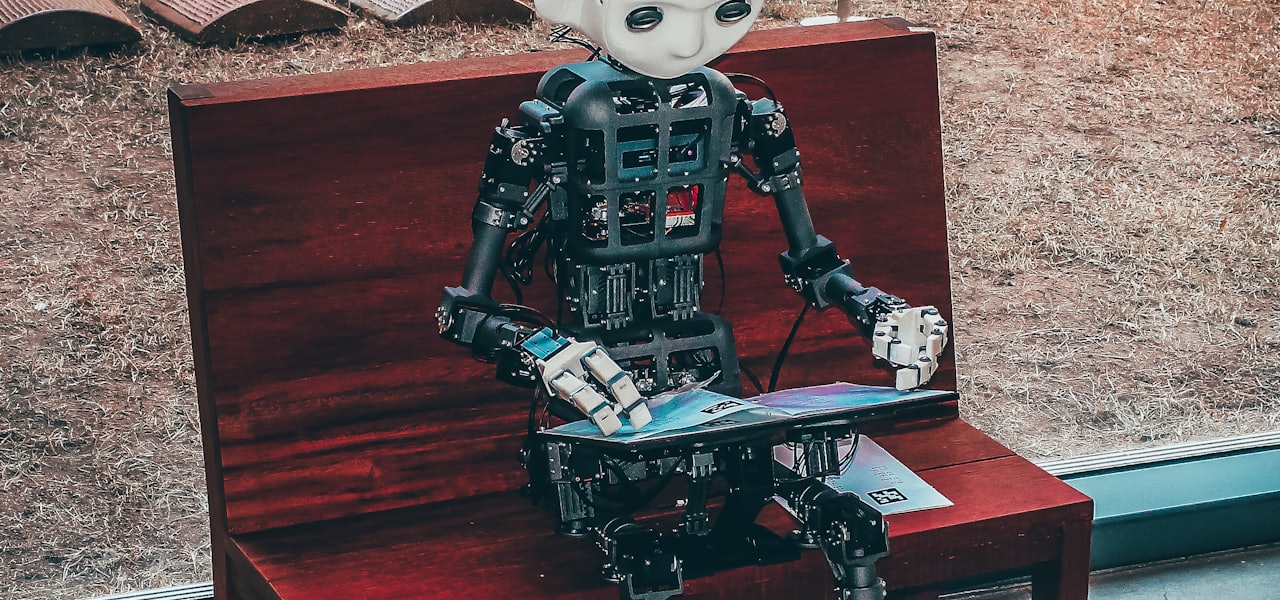
Visual servoing, also known as vision-based robot control and abbreviated VS, is a technique which uses feedback information extracted from a vision sensor (visual feedback) to control the motion of a robot. One of the earliest papers that talks about visual servoing was from the SRI International Labs in 1979. == Visual servoing taxonomy == There are two fundamental configurations of the robot end-effector (hand) and the camera: Eye-in-hand, or end-point open-loop control, where the camera is attached to the moving hand and observing the relative position of the target. Eye-to-hand, or end-point closed-loop control, where the camera is fixed in the world and observing the target and the motion of the hand. Visual Servoing control techniques are broadly classified into the following types: Image-based (IBVS) Position/pose-based (PBVS) Hybrid approach IBVS was proposed by Weiss and Sanderson. The control law is based on the error between current and desired features on the image plane, and does not involve any estimate of the pose of the target. The features may be the coordinates of visual features, lines or moments of regions. IBVS has difficulties with motions very large rotations, which has come to be called camera retreat. PBVS is a model-based technique (with a single camera). This is because the pose of the object of interest is estimated with respect to the camera and then a command is issued to the robot controller, which in turn controls the robot. In this case the image features are extracted as well, but are additionally used to estimate 3D information (pose of the object in Cartesian space), hence it is servoing in 3D. Hybrid approaches use some combination of the 2D and 3D servoing. There have been a few different approaches to hybrid servoing 2-1/2-D Servoing Motion partition-based Partitioned DOF Based == Survey == The following description of the prior work is divided into 3 parts Survey of existing visual servoing methods. Various features used and their impacts on visual servoing. Error and stability analysis of visual servoing schemes. === Survey of existing visual servoing methods === Visual servo systems, also called servoing, have been around since the early 1980s , although the term visual servo itself was only coined in 1987. Visual Servoing is, in essence, a method for robot control where the sensor used is a camera (visual sensor). Servoing consists primarily of two techniques, one involves using information from the image to directly control the degrees of freedom (DOF) of the robot, thus referred to as Image Based Visual Servoing (IBVS). While the other involves the geometric interpretation of the information extracted from the camera, such as estimating the pose of the target and parameters of the camera (assuming some basic model of the target is known). Other servoing classifications exist based on the variations in each component of a servoing system , e.g. the location of the camera, the two kinds are eye-in-hand and hand–eye configurations. Based on the control loop, the two kinds are end-point-open-loop and end-point-closed-loop. Based on whether the control is applied to the joints (or DOF) directly or as a position command to a robot controller the two types are direct servoing and dynamic look-and-move. Being one of the earliest works the authors proposed a hierarchical visual servo scheme applied to image-based servoing. The technique relies on the assumption that a good set of features can be extracted from the object of interest (e.g. edges, corners and centroids) and used as a partial model along with global models of the scene and robot. The control strategy is applied to a simulation of a two and three DOF robot arm. Feddema et al. introduced the idea of generating task trajectory with respect to the feature velocity. This is to ensure that the sensors are not rendered ineffective (stopping the feedback) for any the robot motions. The authors assume that the objects are known a priori (e.g. CAD model) and all the features can be extracted from the object. The work by Espiau et al. discusses some of the basic questions in visual servoing. The discussions concentrate on modeling of the interaction matrix, camera, visual features (points, lines, etc..). In an adaptive servoing system was proposed with a look-and-move servoing architecture. The method used optical flow along with SSD to provide a confidence metric and a stochastic controller with Kalman filtering for the control scheme. The system assumes (in the examples) that the plane of the camera and the plane of the features are parallel., discusses an approach of velocity control using the Jacobian relationship s˙ = Jv˙ . In addition the author uses Kalman filtering, assuming that the extracted position of the target have inherent errors (sensor errors). A model of the target velocity is developed and used as a feed-forward input in the control loop. Also, mentions the importance of looking into kinematic discrepancy, dynamic effects, repeatability, settling time oscillations and lag in response. Corke poses a set of very critical questions on visual servoing and tries to elaborate on their implications. The paper primarily focuses the dynamics of visual servoing. The author tries to address problems like lag and stability, while also talking about feed-forward paths in the control loop. The paper also, tries to seek justification for trajectory generation, methodology of axis control and development of performance metrics. Chaumette in provides good insight into the two major problems with IBVS. One, servoing to a local minima and second, reaching a Jacobian singularity. The author show that image points alone do not make good features due to the occurrence of singularities. The paper continues, by discussing the possible additional checks to prevent singularities namely, condition numbers of J_s and Jˆ+_s, to check the null space of ˆ J_s and J^T_s . One main point that the author highlights is the relation between local minima and unrealizable image feature motions. Over the years many hybrid techniques have been developed. These involve computing partial/complete pose from Epipolar Geometry using multiple views or multiple cameras. The values are obtained by direct estimation or through a learning or a statistical scheme. While others have used a switching approach that changes between image-based and position-based on a Lyapnov function. The early hybrid techniques that used a combination of image-based and pose-based (2D and 3D information) approaches for servoing required either a full or partial model of the object in order to extract the pose information and used a variety of techniques to extract the motion information from the image. used an affine motion model from the image motion in addition to a rough polyhedral CAD model to extract the object pose with respect to the camera to be able to servo onto the object (on the lines of PBVS). 2-1/2-D visual servoing developed by Malis et al. is a well known technique that breaks down the information required for servoing into an organized fashion which decouples rotations and translations. The papers assume that the desired pose is known a priori. The rotational information is obtained from partial pose estimation, a homography, (essentially 3D information) giving an axis of rotation and the angle (by computing the eigenvalues and eigenvectors of the homography). The translational information is obtained from the image directly by tracking a set of feature points. The only conditions being that the feature points being tracked never leave the field of view and that a depth estimate be predetermined by some off-line technique. 2-1/2-D servoing has been shown to be more stable than the techniques that preceded it. Another interesting observation with this formulation is that the authors claim that the visual Jacobian will have no singularities during the motions. The hybrid technique developed by Corke and Hutchinson, popularly called portioned approach partitions the visual (or image) Jacobian into motions (both rotations and translations) relating X and Y axes and motions related to the Z axis. outlines the technique, to break out columns of the visual Jacobian that correspond to the Z axis translation and rotation (namely, the third and sixth columns). The partitioned approach is shown to handle the Chaumette Conundrum discussed in. This technique requires a good depth estimate in order to function properly. outlines a hybrid approach where the servoing task is split into two, namely main and secondary. The main task is keep the features of interest within the field of view. While the secondary task is to mark a fixation point and use it as a reference to bring the camera to the desired pose. The technique does need a depth estimate from an off-line procedure. The paper discusses two examples for which depth estimates are obtained from robot odometry and by assuming that all
Image moment
In image processing, computer vision and related fields, an image moment is a certain particular weighted average (moment) of the image pixels' intensities, or a function of such moments, usually chosen to have some attractive property or interpretation. Image moments are useful to describe objects after segmentation. Simple properties of the image which are found via image moments include area (or total intensity), its centroid, and information about its orientation. == Raw moments == For a 2D continuous function f(x,y) the moment (sometimes called "raw moment") of order (p + q) is defined as M p q = ∫ − ∞ ∞ ∫ − ∞ ∞ x p y q f ( x , y ) d x d y {\displaystyle M_{pq}=\int \limits _{-\infty }^{\infty }\int \limits _{-\infty }^{\infty }x^{p}y^{q}f(x,y)\,dx\,dy} for p,q = 0,1,2,... Adapting this to scalar (grayscale) image with pixel intensities I(x,y), raw image moments Mij are calculated by M i j = ∑ x ∑ y x i y j I ( x , y ) {\displaystyle M_{ij}=\sum _{x}\sum _{y}x^{i}y^{j}I(x,y)\,\!} In some cases, this may be calculated by considering the image as a probability density function, i.e., by dividing the above by ∑ x ∑ y I ( x , y ) {\displaystyle \sum _{x}\sum _{y}I(x,y)\,\!} A uniqueness theorem states that if f(x,y) is piecewise continuous and has nonzero values only in a finite part of the xy plane, moments of all orders exist, and the moment sequence (Mpq) is uniquely determined by f(x,y). Conversely, (Mpq) uniquely determines f(x,y). In practice, the image is summarized with functions of a few lower order moments. === Examples === Simple image properties derived via raw moments include: Area (for binary images) or sum of grey level (for greytone images): M 00 {\displaystyle M_{00}} Centroid: { x ¯ , y ¯ } = { M 10 M 00 , M 01 M 00 } {\displaystyle \{{\bar {x}},\ {\bar {y}}\}=\left\{{\frac {M_{10}}{M_{00}}},{\frac {M_{01}}{M_{00}}}\right\}} == Central moments == Central moments are defined as μ p q = ∫ − ∞ ∞ ∫ − ∞ ∞ ( x − x ¯ ) p ( y − y ¯ ) q f ( x , y ) d x d y {\displaystyle \mu _{pq}=\int \limits _{-\infty }^{\infty }\int \limits _{-\infty }^{\infty }(x-{\bar {x}})^{p}(y-{\bar {y}})^{q}f(x,y)\,dx\,dy} where x ¯ = M 10 M 00 {\displaystyle {\bar {x}}={\frac {M_{10}}{M_{00}}}} and y ¯ = M 01 M 00 {\displaystyle {\bar {y}}={\frac {M_{01}}{M_{00}}}} are the components of the centroid. If ƒ(x, y) is a digital image, then the previous equation becomes μ p q = ∑ x ∑ y ( x − x ¯ ) p ( y − y ¯ ) q f ( x , y ) {\displaystyle \mu _{pq}=\sum _{x}\sum _{y}(x-{\bar {x}})^{p}(y-{\bar {y}})^{q}f(x,y)} The central moments of order up to 3 are: μ 00 = M 00 , μ 01 = 0 , μ 10 = 0 , μ 11 = M 11 − x ¯ M 01 = M 11 − y ¯ M 10 , μ 20 = M 20 − x ¯ M 10 , μ 02 = M 02 − y ¯ M 01 , μ 21 = M 21 − 2 x ¯ M 11 − y ¯ M 20 + 2 x ¯ 2 M 01 , μ 12 = M 12 − 2 y ¯ M 11 − x ¯ M 02 + 2 y ¯ 2 M 10 , μ 30 = M 30 − 3 x ¯ M 20 + 2 x ¯ 2 M 10 , μ 03 = M 03 − 3 y ¯ M 02 + 2 y ¯ 2 M 01 . {\displaystyle {\begin{aligned}\mu _{00}&=M_{00},&\mu _{01}&=0,\\\mu _{10}&=0,&\mu _{11}&=M_{11}-{\bar {x}}M_{01}=M_{11}-{\bar {y}}M_{10},\\\mu _{20}&=M_{20}-{\bar {x}}M_{10},&\mu _{02}&=M_{02}-{\bar {y}}M_{01},\\\mu _{21}&=M_{21}-2{\bar {x}}M_{11}-{\bar {y}}M_{20}+2{\bar {x}}^{2}M_{01},&\mu _{12}&=M_{12}-2{\bar {y}}M_{11}-{\bar {x}}M_{02}+2{\bar {y}}^{2}M_{10},\\\mu _{30}&=M_{30}-3{\bar {x}}M_{20}+2{\bar {x}}^{2}M_{10},&\mu _{03}&=M_{03}-3{\bar {y}}M_{02}+2{\bar {y}}^{2}M_{01}.\end{aligned}}} It can be shown that: μ p q = ∑ m p ∑ n q ( p m ) ( q n ) ( − x ¯ ) ( p − m ) ( − y ¯ ) ( q − n ) M m n {\displaystyle \mu _{pq}=\sum _{m}^{p}\sum _{n}^{q}{p \choose m}{q \choose n}(-{\bar {x}})^{(p-m)}(-{\bar {y}})^{(q-n)}M_{mn}} Central moments are translational invariant. === Examples === Information about image orientation can be derived by first using the second order central moments to construct a covariance matrix. μ 20 ′ = μ 20 / μ 00 = M 20 / M 00 − x ¯ 2 μ 02 ′ = μ 02 / μ 00 = M 02 / M 00 − y ¯ 2 μ 11 ′ = μ 11 / μ 00 = M 11 / M 00 − x ¯ y ¯ {\displaystyle {\begin{aligned}\mu '_{20}&=\mu _{20}/\mu _{00}=M_{20}/M_{00}-{\bar {x}}^{2}\\\mu '_{02}&=\mu _{02}/\mu _{00}=M_{02}/M_{00}-{\bar {y}}^{2}\\\mu '_{11}&=\mu _{11}/\mu _{00}=M_{11}/M_{00}-{\bar {x}}{\bar {y}}\end{aligned}}} The covariance matrix of the image I ( x , y ) {\displaystyle I(x,y)} is now cov [ I ( x , y ) ] = [ μ 20 ′ μ 11 ′ μ 11 ′ μ 02 ′ ] . {\displaystyle \operatorname {cov} [I(x,y)]={\begin{bmatrix}\mu '_{20}&\mu '_{11}\\\mu '_{11}&\mu '_{02}\end{bmatrix}}.} The eigenvectors of this matrix correspond to the major and minor axes of the image intensity, so the orientation can thus be extracted from the angle of the eigenvector associated with the largest eigenvalue towards the axis closest to this eigenvector. It can be shown that this angle Θ is given by the following formula: Θ = 1 2 arctan ( 2 μ 11 ′ μ 20 ′ − μ 02 ′ ) {\displaystyle \Theta ={\frac {1}{2}}\arctan \left({\frac {2\mu '_{11}}{\mu '_{20}-\mu '_{02}}}\right)} The above formula holds as long as: μ 20 ′ − μ 02 ′ ≠ 0 {\displaystyle \mu '_{20}-\mu '_{02}\neq 0} The eigenvalues of the covariance matrix can easily be shown to be λ i = μ 20 ′ + μ 02 ′ 2 ± 4 μ ′ 11 2 + ( μ ′ 20 − μ ′ 02 ) 2 2 , {\displaystyle \lambda _{i}={\frac {\mu '_{20}+\mu '_{02}}{2}}\pm {\frac {\sqrt {4{\mu '}_{11}^{2}+({\mu '}_{20}-{\mu '}_{02})^{2}}}{2}},} and are proportional to the squared length of the eigenvector axes. The relative difference in magnitude of the eigenvalues are thus an indication of the eccentricity of the image, or how elongated it is. The eccentricity is 1 − λ 2 λ 1 . {\displaystyle {\sqrt {1-{\frac {\lambda _{2}}{\lambda _{1}}}}}.} == Moment invariants == Moments are well-known for their application in image analysis, since they can be used to derive invariants with respect to specific transformation classes. The term invariant moments is often abused in this context. However, while moment invariants are invariants that are formed from moments, the only moments that are invariants themselves are the central moments. Note that the invariants detailed below are exactly invariant only in the continuous domain. In a discrete domain, neither scaling nor rotation are well defined: a discrete image transformed in such a way is generally an approximation, and the transformation is not reversible. These invariants therefore are only approximately invariant when describing a shape in a discrete image. === Translation invariants === The central moments μi j of any order are, by construction, invariant with respect to translations. === Scale invariants === Invariants ηi j with respect to both translation and scale can be constructed from central moments by dividing through a properly scaled zero-th central moment: η i j = μ i j μ 00 ( 1 + i + j 2 ) {\displaystyle \eta _{ij}={\frac {\mu _{ij}}{\mu _{00}^{\left(1+{\frac {i+j}{2}}\right)}}}\,\!} where i + j ≥ 2. Note that translational invariance directly follows by only using central moments. === Rotation invariants === As shown in the work of Hu, invariants with respect to translation, scale, and rotation can be constructed: I 1 = η 20 + η 02 {\displaystyle I_{1}=\eta _{20}+\eta _{02}} I 2 = ( η 20 − η 02 ) 2 + 4 η 11 2 {\displaystyle I_{2}=(\eta _{20}-\eta _{02})^{2}+4\eta _{11}^{2}} I 3 = ( η 30 − 3 η 12 ) 2 + ( 3 η 21 − η 03 ) 2 {\displaystyle I_{3}=(\eta _{30}-3\eta _{12})^{2}+(3\eta _{21}-\eta _{03})^{2}} I 4 = ( η 30 + η 12 ) 2 + ( η 21 + η 03 ) 2 {\displaystyle I_{4}=(\eta _{30}+\eta _{12})^{2}+(\eta _{21}+\eta _{03})^{2}} I 5 = ( η 30 − 3 η 12 ) ( η 30 + η 12 ) [ ( η 30 + η 12 ) 2 − 3 ( η 21 + η 03 ) 2 ] + ( 3 η 21 − η 03 ) ( η 21 + η 03 ) [ 3 ( η 30 + η 12 ) 2 − ( η 21 + η 03 ) 2 ] {\displaystyle I_{5}=(\eta _{30}-3\eta _{12})(\eta _{30}+\eta _{12})[(\eta _{30}+\eta _{12})^{2}-3(\eta _{21}+\eta _{03})^{2}]+(3\eta _{21}-\eta _{03})(\eta _{21}+\eta _{03})[3(\eta _{30}+\eta _{12})^{2}-(\eta _{21}+\eta _{03})^{2}]} I 6 = ( η 20 − η 02 ) [ ( η 30 + η 12 ) 2 − ( η 21 + η 03 ) 2 ] + 4 η 11 ( η 30 + η 12 ) ( η 21 + η 03 ) {\displaystyle I_{6}=(\eta _{20}-\eta _{02})[(\eta _{30}+\eta _{12})^{2}-(\eta _{21}+\eta _{03})^{2}]+4\eta _{11}(\eta _{30}+\eta _{12})(\eta _{21}+\eta _{03})} I 7 = ( 3 η 21 − η 03 ) ( η 30 + η 12 ) [ ( η 30 + η 12 ) 2 − 3 ( η 21 + η 03 ) 2 ] − ( η 30 − 3 η 12 ) ( η 21 + η 03 ) [ 3 ( η 30 + η 12 ) 2 − ( η 21 + η 03 ) 2 ] . {\displaystyle I_{7}=(3\eta _{21}-\eta _{03})(\eta _{30}+\eta _{12})[(\eta _{30}+\eta _{12})^{2}-3(\eta _{21}+\eta _{03})^{2}]-(\eta _{30}-3\eta _{12})(\eta _{21}+\eta _{03})[3(\eta _{30}+\eta _{12})^{2}-(\eta _{21}+\eta _{03})^{2}].} These are well-known as Hu moment invariants. The first one, I1, is analogous to the moment of inertia around the image's centroid, where the pixels' intensities are analogous to physical density. The first six, I1 ... I6, are reflection symmetric, i.e. they are unchanged if the image is changed to a mirror image. The last one, I7, is reflection antisymmetric (changes sign under reflection), which enables it to distinguish mirror images of otherwise identical im
Free Studio
Free Studio is a freeware set of multimedia computer programs developed by DVDVideoSoft. The programs are available in one integrated package and also as separate downloads (Free Studio Manager is included in both). == Overview == The Free Studio software bundle consists of about 48 programs, grouped into several sections: YouTube, MP3 & Audio, CD-DVD-BD, DVD & Video, Photo & Images, Mobiles, Apple Devices, and 3D. The largest group is the DVD & Video section containing 14 different applications. Mobiles section is the second largest group with 13 programs. However, the YouTube section, particularly YouTube downloading programs, has gained more popularity among users. The programs have been tested and endorsed by a dozen of software portals and have won awards from these sites. Free Studio is most popular in Germany, Greece, Italy, and the United States. It is also popular in Japan, France, and the United Kingdom. Some of the programs in the package are free and open-source software. == History == DVDVideoSoft project was launched in 2006 by company Digital Wave Ltd., for software development to produce multimedia application software. The founders distributed paid software as an affiliate at the start, later their own products appeared on the site. Free YouTube Download was the first successful program, then DVDVideoSoft created and launched several other 'Free YouTube' applications. Later on upon users' requests DVDVideoSoft started developing other kinds of applications including media converters etc. Today DVDVideoSoft offers up to 49 different programs for video, audio and image processing individually or integrated into the Free Studio package. == Features == DVDVideoSoft YouTube programs can be used to download YouTube videos in their original format and convert them to AVI, DVD, MP4, WMV etc. or different audio formats. YouTube section contains Free Video Call Recorder for Skype button, but the program itself is not included into FS installation (it has to be downloaded and installed separately). The "MP3 & Audio" section consists of the programs which convert audio files between different formats, convert audio files to Flash for web, extract audio from video files, edit audio files (Free Audio Dub), rip and burn CDs. Enclosed in the CD-DVD-BD section are the applications that enable users to burn files and folders to discs, to convert videos to a DVD format and vice versa, to burn CDs, and to copy music from audio CDs into files. The "DVD and Video" section contains several desktop video and DVD converters. Some of the programs can flip, rotate and cut (Free Video Dub) videos. One of the most popular programs from the section is Free Video Dub. Converted videos are now, contrary to previous versions, watermarked if no paid membership is present. Free Studio includes several applications for Apple phones, iPods and other devices. The Mobiles section contains a dozen video converters for various mobile devices such as cell phones, Tablets and Game consoles. They convert videos to play them on (BlackBerry, HTC, LG phones, Sony/Sony Ericsson, Nintendo, Xbox, Motorola phones, etc.) The "Photo & Images" section incorporates the programs for image conversion and resizing, extracting JPEG frames from videos (Free Video To JPEG Converter), recording screen activities, making screenshots (Free Screen Recorder). The 3D section is composed of the programs to make 3D videos and 3D images. There are several algorithms which allow to create different types of 3D images. == Supported formats == === Video formats === Input: .avi; .ivf; .div; .divx; .mpg; .mpeg; .mpe; .mp4; .m4v; .wmv; .asf; .webm; .mkv; .mov; .qt; .ts; .mts; .m2t; .m2ts; .mod; .tod; .vro; .dat; .3gp2; .3gpp; .3gp; .3g2; .dvr-ms; .flv; .f4v; .amv; .rm; .rmm; .rv; .rmvb; .ogv; DVD video Output: .mp4; .wmv; .avi; .mkv; .webm; .flv; .swf; .mov; .3gp; .m2ts; DVD video === Audio formats === Input: .mp3 .wav; .aac; .m4a; .m4b; .wma; .ogg; .flac; .ra; .ram; .amr; .ape; .mka; .tta; .aiff; .au; .mpc; .spx; .ac3; audio cd Output: .mp3; .m4a; .aac; .wav; .wma; .ogg; .flac; .ape; audio CD === Image formats === Input: .jpg, .png, .bmp, .gif, .tga Output: .jpg, .png, .bmp, .gif, .tga, .pdf == Reception == The programs have been tested and endorsed by Chip Online, Tucows, SnapFiles, Brothersoft, and Softonic and have won awards from these sites. Free Studio is most popular in Germany, United States and Italy. It is also popular in Japan, France and the United Kingdom. The most popular applications, according to CNET statistics, include Free YouTube to MP3 Converter, Free Video to MP3 Converter, Free MP4 Video Converter and Free YouTube Download. Other programs with high rank: Free AVI Video Converter, Free Video Editor, Free Audio Converter and Free Studio in a whole. == Criticism == Free Studio (as can be common for freeware packages) is criticized for toolbar and Web search engine installation. Older versions have also included OpenCandy, which is loaded automatically, with no request for user approval. There can be difficulties installing only the programs needed without installing bundled extra programs. In March 2017, DVDVideoSoft announced that it had stopped showing other products' ads during installation and removed all toolbars, search engines, and OpenCandy.
Intrinsic dimension
In mathematics, the intrinsic dimension of a subset can be thought of as the minimal number of variables needed to represent the subset. The concept has widespread applications in geometry, dynamical systems, signal processing, statistics, and other fields. Due to its widespread applications and vague conceptualization, there are many different ways to define it rigorously. Consequently, the same set might have different intrinsic dimensions according to different definitions. The intrinsic dimension can be used as a lower bound of what dimension it is possible to compress a data set into through dimension reduction, but it can also be used as a measure of the complexity of the data set or signal. For a data set or signal of N variables, its intrinsic dimension M satisfies 0 ≤ M ≤ N, although estimators may yield higher values. == Exact dimension == === Differential === In differential geometry, given a differentiable manifold N and a submanifold M, the intrinsic dimension of M is its dimension. Suppose N has n dimensions and M has m dimensions, then that means around any point in M, there exists a local coordinate system ( x 1 , … , x m , x m + 1 , … , x n ) {\displaystyle (x_{1},\dots ,x_{m},x_{m+1},\dots ,x_{n})} of N, such that the manifold M is simply the subset of N defined by x m + 1 = 0 , … , x n = 0 {\displaystyle x_{m+1}=0,\dots ,x_{n}=0} . === Metric === Given a mere metric space, we can still define its intrinsic dimension. The most general case is the Hausdorff dimension, though for metric spaces occurring in practice, the box-counting dimension and the packing dimension often are identical to the Hausdorff dimension. Let X , d {\textstyle X,d} be a metric space and A ⊂ X {\textstyle A\subset X} be totally bounded. Define the covering number N ( A , ε ) = min { k : A ⊂ ⋃ i = 1 k B ( x i , ε ) } . {\displaystyle N(A,\varepsilon )=\min \left\{k:A\subset \bigcup _{i=1}^{k}B\left(x_{i},\varepsilon \right)\right\}.} The metric entropy is H ( A , ε ) = log N ( A , ε ) {\textstyle H(A,\varepsilon )=\log N(A,\varepsilon )} (any log base). The upper and lower metric entropy dimensions are dim ¯ E A = lim sup ε ↓ 0 H ( A , ε ) log ( 1 / ε ) , dim _ E A = lim inf ε ↓ 0 H ( A , ε ) log ( 1 / ε ) . {\displaystyle {\overline {\dim }}_{E}A=\limsup _{\varepsilon \downarrow 0}{\frac {H(A,\varepsilon )}{\log(1/\varepsilon )}},\quad {\underline {\dim }}_{E}A=\liminf _{\varepsilon \downarrow 0}{\frac {H(A,\varepsilon )}{\log(1/\varepsilon )}}.} If they are equal, then dim E A {\textstyle \operatorname {dim} _{E}A} is that common value, called the metric entropy dimension. The entropy dimensions are usually used in information theory, and especially coding theory, since entropy is involved in its definition. === Topological === If X {\displaystyle X} is merely a topological space, then we can still define its intrinsic dimension, using the topological dimension or Lebesgue covering dimension. An open cover of a topological space X is a family of open sets Uα such that their union is the whole space, ∪ α {\displaystyle \cup _{\alpha }} Uα = X. The order or ply of an open cover A {\displaystyle {\mathfrak {A}}} = {Uα} is the smallest number m (if it exists) for which each point of the space belongs to at most m open sets in the cover: in other words Uα1 ∩ ⋅⋅⋅ ∩ Uαm+1 = ∅ {\displaystyle \emptyset } for α1, ..., αm+1 distinct. A refinement of an open cover A {\displaystyle {\mathfrak {A}}} = {Uα} is another open cover B {\displaystyle {\mathfrak {B}}} = {Vβ}, such that each Vβ is contained in some Uα. The covering dimension of a topological space X is defined to be the minimum value of n such that every finite open cover A {\displaystyle {\mathfrak {A}}} of X has an open refinement B {\displaystyle {\mathfrak {B}}} with order n + 1. The refinement B {\displaystyle {\mathfrak {B}}} can always be chosen to be finite. Thus, if n is finite, Vβ1 ∩ ⋅⋅⋅ ∩ Vβn+2 = ∅ {\displaystyle \emptyset } for β1, ..., βn+2 distinct. If no such minimal n exists, the space is said to have infinite covering dimension. == Introductory example == Let f ( x 1 , x 2 ) {\textstyle f(x_{1},x_{2})} be a two-variable function (or signal) which is of the form f ( x 1 , x 2 ) = g ( x 1 ) {\textstyle f(x_{1},x_{2})=g(x_{1})} for some one-variable function g which is not constant. This means that f varies, in accordance to g, with the first variable or along the first coordinate. On the other hand, f is constant with respect to the second variable or along the second coordinate. It is only necessary to know the value of one, namely the first, variable in order to determine the value of f. Hence, it is a two-variable function but its intrinsic dimension is one. A slightly more complicated example is f ( x 1 , x 2 ) = g ( x 1 + x 2 ) {\textstyle f(x_{1},x_{2})=g(x_{1}+x_{2})} . f is still intrinsic one-dimensional, which can be seen by making a variable transformation y 1 = x 1 + x 2 {\textstyle y_{1}=x_{1}+x_{2}} and y 2 = x 1 − x 2 {\textstyle y_{2}=x_{1}-x_{2}} which gives f ( y 1 + y 2 2 , y 1 − y 2 2 ) = g ( y 1 ) {\textstyle f\left({\frac {y_{1}+y_{2}}{2}},{\frac {y_{1}-y_{2}}{2}}\right)=g\left(y_{1}\right)} . Since the variation in f can be described by the single variable y1 its intrinsic dimension is one. For the case that f is constant, its intrinsic dimension is zero since no variable is needed to describe variation. For the general case, when the intrinsic dimension of the two-variable function f is neither zero or one, it is two. In the literature, functions which are of intrinsic dimension zero, one, or two are sometimes referred to as i0D, i1D or i2D, respectively. == Signal processing == In signal processing of multidimensional signals, the intrinsic dimension of the signal describes how many variables are needed to generate a good approximation of the signal. For an N-variable function f, the set of variables can be represented as an N-dimensional vector x: f = f ( x ) where x = ( x 1 , … , x N ) {\textstyle f=f\left(\mathbf {x} \right){\text{ where }}\mathbf {x} =\left(x_{1},\dots ,x_{N}\right)} . If for some M-variable function g and M × N matrix A it is the case that for all x; f ( x ) = g ( A x ) , {\textstyle f(\mathbf {x} )=g(\mathbf {Ax} ),} M is the smallest number for which the above relation between f and g can be found, then the intrinsic dimension of f is M. The intrinsic dimension is a characterization of f, it is not an unambiguous characterization of g nor of A. That is, if the above relation is satisfied for some f, g, and A, it must also be satisfied for the same f and g′ and A′ given by g ′ ( y ) = g ( B y ) {\textstyle g'\left(\mathbf {y} \right)=g\left(\mathbf {By} \right)} and A ′ = B − 1 A {\textstyle \mathbf {A'} =\mathbf {B} ^{-1}\mathbf {A} } where B is a non-singular M × M matrix, since f ( x ) = g ′ ( A ′ x ) = g ( B A ′ x ) = g ( A x ) {\textstyle f\left(\mathbf {x} \right)=g'\left(\mathbf {A'x} \right)=g\left(\mathbf {BA'x} \right)=g\left(\mathbf {Ax} \right)} . == The Fourier transform of signals of low intrinsic dimension == An N variable function which has intrinsic dimension M < N has a characteristic Fourier transform. Intuitively, since this type of function is constant along one or several dimensions its Fourier transform must appear like an impulse (the Fourier transform of a constant) along the same dimension in the frequency domain. === A simple example === Let f be a two-variable function which is i1D. This means that there exists a normalized vector n ∈ R 2 {\textstyle \mathbf {n} \in \mathbb {R} ^{2}} and a one-variable function g such that f ( x ) = g ( n T x ) {\textstyle f(\mathbf {x} )=g(\mathbf {n} ^{\operatorname {T} }\mathbf {x} )} for all x ∈ R 2 {\textstyle \mathbf {x} \in \mathbb {R} ^{2}} . If F is the Fourier transform of f (both are two-variable functions) it must be the case that F ( u ) = G ( n T u ) ⋅ δ ( m T u ) {\textstyle F\left(\mathbf {u} \right)=G\left(\mathbf {n} ^{\mathrm {T} }\mathbf {u} \right)\cdot \delta \left(\mathbf {m} ^{\mathrm {T} }\mathbf {u} \right)} . Here G is the Fourier transform of g (both are one-variable functions), δ is the Dirac impulse function and m is a normalized vector in R 2 {\textstyle \mathbb {R} ^{2}} perpendicular to n. This means that F vanishes everywhere except on a line which passes through the origin of the frequency domain and is parallel to m. Along this line F varies according to G. === The general case === Let f be an N-variable function which has intrinsic dimension M, that is, there exists an M-variable function g and M × N matrix A such that f ( x ) = g ( A x ) ∀ x {\textstyle f(\mathbf {x} )=g(\mathbf {Ax} )\quad \forall \mathbf {x} } . Its Fourier transform F can then be described as follows: F vanishes everywhere except for a subspace of dimension M The subspace M is spanned by the rows of the matrix A In the subspace, F varies according to G the Fourier transform of g == Generalizations == The type of intrinsic dimension described above assume